This writers assignment guide (WAG) was designed to be used in a 3rd grade classroom during the Social Studies. It was created to give students all the relevant information they need about an assignment.
Writing Task: Write an informational paragraph explaining ways the people of Ancient Egypt adapted to their environment and successfully created a civilization.
SOL: 3.7 The student will describe how people in ancient world cultures adapted to their environment.
Audience: Teacher and classmates
Purpose: To review and remember information about Ancient Egypt for the unit test.
Length: One paragraph
Directions and requirements:
- Provide a topic sentence
- Include 3 or more supporting details/reasons
- Provide a concluding sentence
- Use complete sentences that begin with a capital letter and end with punctuation
- This assignment with be graded and will count as a classwork grade
- Turn in your graphic organizer and your paragraph
Writing Supports:
- Complete the graphic organizer before you start writing
- Refer to the Study Guide in your folder
- Pebble Go may also be used
Rubric:
| 3 | 2 | 1 | |
| Begins with a topic sentence | Paragraph begins with a topic sentence | Topic sentence was attempted, but is not clear | No attempt was made to start with a topic sentence |
| Includes 3 or more details | Includes 3 or more details | Includes 2 details | Includes 1 or no details |
| Ends with a concluding sentence | Paragraph ends with a concluding sentence | Concluding sentence was attempted, but not clear | No attempt was made to end with a concluding sentence |
| Uses Complete sentences | All sentences are complete with no errors | Most sentences are complete, but has a few errors | Paragraph contains many incomplete sentences |
| Uses capital letter to begin and punctuation to end sentences | All sentences begin with capital letters and end with punctuation. | Most sentences begin with capital letters and end with punctuation, but has a few errors. | Paragraph is missing many capital letters and punctuation. |
Example:
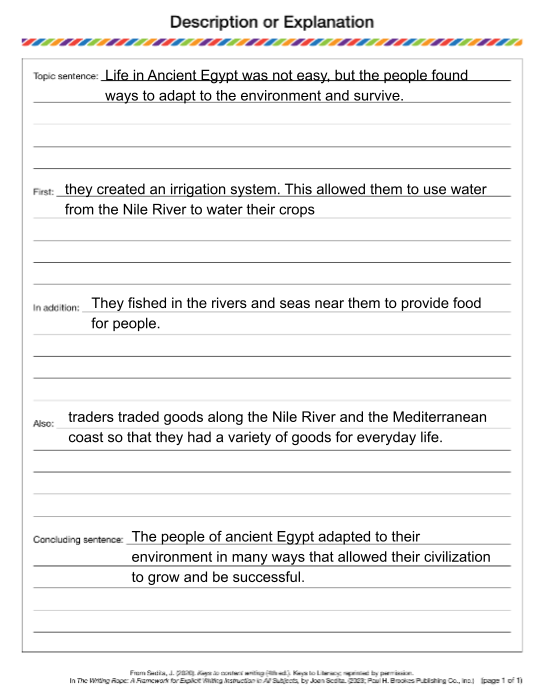
Life in Ancient Egypt was not easy, but the people found ways to adapt to the environment and survive. First, they created an irrigation system. This allowed them to use water from the Nile River to water their crops. In addition, they fished in the rivers and seas near them to provide food for people. Also, traders traded goods along the Nile River and the Mediterranean coast so that they had a variety of goods for everyday life. The people of ancient Egypt adapted to their environment in many ways that allowed their civilization to grow and be successful.
Reflection – Writing this lesson was very eye opening to me and what might have been missing from my instruction previously, clear explicit direction and expectations. I like the WAG and the idea of giving my 3rd grade students all the information they need/want upfront and very clearly. At the age of 8-9 I don’t think that I would distribute a copy to each student, but I think it is a good format to display when going over the assignment. I will be interested to see this year if but displaying this it cuts down on the questions they have about an assignment and if the quality of their work improves. I can’t wait to try it out!