This lesson was designed to be used as a whole group lesson in a 2nd grade classroom during the language arts block. It was designed in response to a student writing sample that showed weakness in verb tense.
 For this lesson I chose to look at Kelsey’s writing sample. The sample is from the beginning of her 2nd grade year.
Kelsey has good ideas for her writing. She understands the basic principle that a sentence needs a subject and a predicate and must start with a capital letter and end with punctuation.
Kelsey has several areas of weakness though that will all need to be addressed gradually. She has poor handwriting skills and has several reversals. She often omits words in her sentences which causes confusion for the reader. She also struggles with subject verb agreement as well as verb tense. She also uses simple sentences that lack variety.
| Lesson Goal | To help students construct better sentences by increasing the students’ syntactic awareness so they are able to hear and fix errors in past, present, and future verb tenses. |
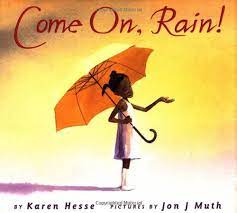
| Introduction | For this lesson I will stick with the weather theme that Kelsey drew and wrote about, which is also a science topic covered in 2nd grade. I would begin by stating that the words an author uses tells the reader if something is happening right now, is going to happen later in the future, or has already happened in the past. Then I would read aloud the book Come On, Rain! By Karen Hesse. |
| I Do | After reading the story, I would write on the board the sentence from the story that says, “We turn in circles, glistening in our rain skin.”
I would explain to the students that I know this is happening right now (in the present tense) because of the verbs the author used. The words turn and glistening tell me that it is something the characters in the book are doing right now. It is happening in the present tense. I would begin to fill in an anchor chart with 3 columns, Past, Present, and Future. I would add turn to the present column. Then, I would swap out turn for turned and glistening for glistened. I would read the new sentence aloud and tell the students that if the author had written it this way, then I would know the characters already did something. That it has already happened (past tense). I would add turned and glistening to the past column. Next, I would swap out turn for will turn and glistening for will glisten. I would read the new sentence aloud and explain to the students that written this way I would know that something is going to happen, but hasn’t happened yet (future tense). I would add will turn and will glisten to the future column. |
| We Do | Then I would start with a new sentence. This time I would write “Momma sinks into a kitchen chair and sweeps off her hat.” on the board. I would have student volunteers help me identify the 2 verbs in the sentence. (sinks and sweeps). Then ask them when in the story this is happening, right now, in the future, or in the past, guiding them to the correct answer. We would add the new words to the correct column of the anchor chart.
Then, I would swap out sinks for sank and sweeps for swept. I would read the new sentence aloud and ask the student how my sentence changed and guide them to tell me that now the sentence has already happened (past tense). We would add the new words to the correct column of the anchor chart. Next, I would swap out sinks for will sink and sweeps for will sweep. I would read the new sentence aloud and ask the student how my sentence changed and guide them to tell me that now the sentence is going to happen, but hasn’t happened yet (future tense). We would add the new words to the correct column of the anchor chart. |
| You Do | Finally, I would hand out sentence strips to each table with the sentence, “I am sizzling like a hot potato.” on them. Then, I would ask them to work with their table partner to identify the verb in the sentence.
After going around to each group to ensure they have identified the verb, I would give them a post it note and ask them to change the verb so that it is now a past tense verb. I would make another loop to ensure all groups have correctly changed the verb tense and give guidance to any that have not. We would add the new word to the correct column of the anchor chart. Finally, I would give each group another post it and ask that they now change it to a future tense. Again circulating around the room to provide immediate feedback to any groups that struggle. We would add the new words to the correct column of the anchor chart. |
| Closing | To close out the lesson, I would ask each student to pull out their writing. I would ask them to pick a sentence to read to their table partner. Then their partner would tell them if the sentence is happening in the present, past, or in the future. Students would be allowed to edit their papers if they found an error in the verb tense. Then they will repeat with their partner reading a sentence and the first student identifying the tense. |
Reflection – Writing this lesson was actually a lot of fun! I love the vivid vocabulary in this book and thought it was the perfect opportunity to help Kelsey and her classmates increase their syntactic awareness so they are able to hear and fix errors in past, present, and future verb tenses. I considered only focusing the lesson on past and present verb tenses, however I believe that the three work nicely together and that students in second grade could handle all three. By doing them together I think it will give the students the opportunity to do some good comparisons. I do want to continue to look more at sample student writing so that I become more confident in finding errors and addressing them within writing.