This lesson was designed to be used in a 3rd grade classroom during the language arts block. It was designed to teach students about using apostrophes in contractions with pronouns with a mentor text as a guide.
Apostrophes
This lesson is designed as a whole group lesson for 3rd grade students.
Standard(s): 3.9 The student will edit writing for capitalization, punctuation, spelling, and Standard English.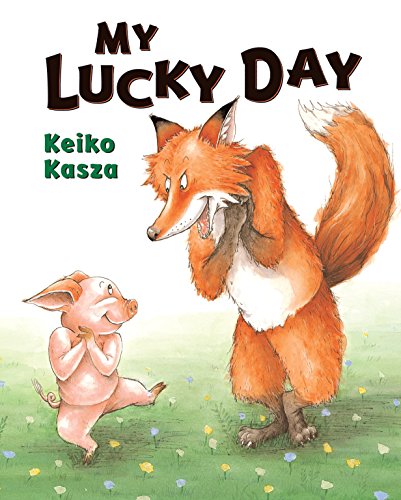
- h) Use apostrophes in contractions with pronouns and in possessives.
Purpose/Why Learn This? To introduce students to contractions and the use of apostrophes with pronouns.
Materials Needed:
- Copy of My Lucky Day by Keiko Kasza
- Document Camera
- Dry erase board and markers
- Dry erase magnetic sentence strips
- Student dry erase boards and markers
Procedures:
1. Introduction – Say, “Sometimes when we talk we run two words together and it turns into one word, this is called a contraction. An example would be when I say, she’ll go this afternoon instead of saying she will go this afternoon. Did you hear the difference in my words? Look at the difference in the way these 2 words are written.”
Write both words on the board.
Say, – “Authors like to do the same thing when they write, especially when they write words a character is saying. It makes the writing sound a little less formal and more like someone is really talking. This is done a lot with pronouns. Who can remind me what a pronoun is?”
Call on a student.
Say, “Yes, that is correct, a pronoun is a word that takes the place of a noun like me, they, and you. Today we are going to read the story My Lucky Day. While I read it aloud to you I’m going to project the story so you can see the words on each page. Listen and watch as I read and see if you can find places in the story where the author uses pronoun contractions.”
2. Activities
- I Do
Reading through the story aloud.
Turn back to the page (pages premarked with post it notes) with the word “he’s” on it.
Point to the word you’re. Say, “I see here that the author has used a contraction to combine two words, he and has.”
Write the words he and has on 2 sentence strips beside each other on the dry erase board with a space between them. Say, “When you write a contraction you take some of the letters out of the second word and replace them with an apostrophe. So the author took the space out from between the words, removed the letters h a, and replaced them with an apostrophe.”
Slide the 2 sentence strips together to remove the space between them, erase the h and a.
Say, “Watch how I make an apostrophe on my sentence strip. I start here and move my marker down like this.” Demonstrate how to make an apostrophe.
Say, “Now my words have made the contraction that the author used in the story.”
- We Do
Turn to the page with the word “you’ve” written on it. Say, “Let’s look at this word together. What two words did the author combine to create this contraction?”
Call on a student and give guidance as needed to help them determine that the words are you and have. Write the two words on the magnet strips with a space in between them.
Say, “Let’s check and make sure our two words make sense in the sentence. Would the sentence still make sense if it said, ‘You have come to the right place’? “
Call on a student.
Say, “Yes, it does still make sense to us as the readers. Now what did the author do to those two words to create a contraction?” Call on a student.
Say, “Yes, that is correct. They took away the space between the 2 words, (remove the space between the words) and dropped the letters h and a and replaced them with an apostrophe.” Erase the letters and replace them with an apostrophe.
Say, “Have we created the contraction just like the author? Yes, let’s look at another example”
Repeat the same procedure focusing on the page with the word “I’d”.
- You Do
Say, “Now I’d like you to get out your dry erase board and marker and try some just like we’ve done together.”
Turn to the page in the book with “I’m” and point to the word.
Say, “Now on your dry erase board I want you to write the two words the author combined to make a contraction. I will be around, so if you need help please raise your hand.”
Circulate around the room and provide assistance and immediate feedback to all students.
Say, “Let’s turn those 2 words back into the contraction the author used. Go ahead and show me how we do that.”
Circulate around the room and provide assistance and immediate feedback to all students. Assess student understanding and identify students who may need additional support and scaffolding in a tier 2 group.
Say, “Great job.” Let’s try another one. Display the word shouldn’t. Point to the word.
Repeat the same procedure.
Say, “Nice Work.” Let’s do one more. Display the word “you’re”. Point to the word.
Repeat the same procedure.
3. Conclusion – Say, “You all did really well looking at making pronoun contractions using an apostrophe today. This is a skill we will continue working on. As you become familiar and comfortable with pronoun contractions I’d like to start seeing you use them in your writings, journal responses, and when you answer a question. Go ahead and put your materials away.”
Future Lessons: During the next lesson students would learn about apostrophes to show possession.
Reflection – Creating this lesson plan was really beneficial. For one thing, it caused me to take a close look at the standards for writing for 3rd graders, and relook at them because I had interpreted this standard wrong. The mentor text I selected was a book I was familiar with, so I knew that it had a large variety of pronoun contractions. I enjoyed revisiting the book and thinking about the way I would use it, and the words I would say to my future students. I’ve never explicitly taught pronoun contractions, so it took some time to think through. I decided I needed to separate the standard into 2 parts and focus this lesson only on pronoun contractions. I don’t want to overwhelm the students with too much information at one time. In the future I would find a mentor text to show lots of examples of apostrophes that show possession and create a lesson to cover the 2nd part of the standard as well. I’m pleased with the way the lesson came out on my 2nd attempt, and look forward to using this lesson with my students this coming school year.